Welcome to Shanghai
China's gateway to the world
Shanghai is China's most cosmopolitan metropolis, where timeless classical architecture, futuristic skyscrapers, quiet old alleyways, and serene riverside districts blend harmoniously. Situated at the mouth of the Yangtze River, it has long stood as China's vital gateway to the globe — shaped by centuries of trade, cultural integration, and relentless reinvention.
Far beyond well-known scenic spots, Shanghai's true charm lies in its subtle daily moments: the sleek geometric outlines of Art Deco buildings on a quiet morning, the unhurried pace of traditional lilong lanes, a vintage jazz bar tucked away among lush roadside trees, or an avant-garde art museum renovated from a historic industrial venue.
Architecture & History
Art Deco waterfronts, stone-gate lane houses, colonial-era concessions, and a futuristic Pudong skyline — few cities offer such architectural range in a single day's walk.
Café & Lane Culture
One of the world's densest specialty coffee scenes, tucked inside old villas and lilong lanes. Shanghai is a city best explored slowly, on foot, with nowhere urgent to be.
Art & Design
A thriving contemporary art scene anchored by West Bund museums, repurposed industrial galleries, and a fashion industry that sets trends across China.
Easy for Foreigners
More English signage, more international restaurants, and more experience handling foreign visitors than almost anywhere else in mainland China.
Best Time to Visit
History & Architecture
How Shanghai became what it is today
Before the 19th century, Shanghai was a modest riverside town. After the First Opium War (1840–1842), it opened as a treaty port, drawing foreign businesses, banks, and entire international communities from Britain, France, and beyond. By the 1920s and 1930s it had become Asia's financial capital — a hub for cinema, jazz, publishing, and fashion — earning the nickname "Paris of the East."
That golden era left a permanent mark on the city's visual identity. Today Shanghai's urban landscape functions as a living timeline, layering colonial concessions, stone-gate lane houses, Art Deco towers, and gleaming Pudong skyscrapers all within walking distance of each other. Architecture is one of the best ways to understand this city.
Bund Eclectic Style
Neoclassical, Gothic Revival, Baroque, and Art Deco — all built along one waterfront between the 1920s and 1930s. The world's most concentrated collection of colonial-era financial architecture.
Art Deco Shanghai
Shanghai holds one of the largest surviving Art Deco collections on earth. Look for geometric decoration, streamlined facades, and elegant original lobbies in former hotels and apartment buildings.
Shikumen & Lilong
Stone-gate houses blending Western row-house layouts with Chinese courtyard living, connected by narrow lanes called lilong. Many have been converted into cafés, studios, and bookshops.
Pudong Futurism
Lujiazui's skyline — Shanghai Tower, Oriental Pearl, Jin Mao, SWFC — barely existed before 1990. The most vivid symbol of China's economic transformation, visible from across the river.
Areas & Sights
Where to go and what to see in each district
Shanghai divides into Puxi (west bank, older city — where almost all the character lives) and Pudong (east bank, modern financial district). The districts below cover everything most visitors need, in rough geographic order from the riverfront outward.
Shanghai's most famous stretch — a riverside promenade lined with colonial-era banks, customs houses, and hotels facing Lujiazui's skyline across the Huangpu River. Walk it in the morning for calm light and architectural detail; return after dark for the full panoramic drama. Completely free, always open.
The most liveable and atmospheric district for visitors. Tree-lined streets, plane trees overhead, shikumen lane houses converted into cafés, boutiques, and galleries. Wukang Road and Anfu Road are the spiritual centre — endlessly photogenic, full of local character, and extremely walkable. This is Shanghai's most walkable district.
Shanghai has several active Buddhist temples that have survived the city's relentless transformation — each with a distinct character, age, and history. These are genuine places of worship: incense burns year-round, monks go about their routines, and local worshippers arrive at dawn. For temple etiquette and how to visit respectfully, see the Culture guide.
Xintiandi is Shanghai's most polished example of shikumen restoration — two blocks of stone-gate lane houses transformed into upscale restaurants, bars, and cafés while preserving the original architecture. It's more curated than Tianzifang and less gritty, but offers the easiest and most comfortable introduction to old Shanghai's architectural character. A popular first-night dinner destination for visitors arriving in the city.
The Old City (Nanshi) is the oldest surviving urban district in Shanghai — a walled city that existed centuries before the foreign concessions arrived. The streets here are denser, older, and less curated than Xintiandi, centred on Yu Garden and its surrounding bazaar. It's touristy around the garden itself, but the surrounding lanes contain some of the oldest urban fabric still standing in the city.
The Lujiazui financial district is where Shanghai's iconic skyline physically lives. Shanghai Tower, the Oriental Pearl TV Tower, Jin Mao Tower, and the SWFC all cluster here — best appreciated from across the river on the Bund, or from above on an observation deck. The wider Pudong area also has Shanghai Disney Resort further east.
The West Bund is Shanghai's leading contemporary art district — a stretch of former industrial waterfront south of the French Concession, transformed over the past decade into a world-class corridor of museums and creative spaces. Former power stations, oil tanks, and warehouses have been reimagined into venues housing Pompidou-affiliated collections, photography archives, and experimental installations. The riverside walk between them is free, scenic, and largely free of tourists.
North of the Bund, Hongkou is one of Shanghai's most layered and least-visited historic districts. It was once the city's Japanese quarter and later sheltered thousands of Jewish refugees fleeing Europe in the late 1930s — the only place in the world that accepted them without a visa. Today the district is undergoing gradual regeneration while retaining its older streetscapes and residential character, offering a very different mood from the polished concession areas to the south.
Suzhou Creek winds through the northern edge of the city, and its former industrial waterfront has become one of Shanghai's most interesting creative corridors. Textile mills, warehouses, and factories that once powered the city's 20th-century economy have been repurposed into galleries, studios, and cultural venues — a quieter, less polished version of the West Bund transformation, with more of the raw industrial character still visible.
Itineraries
Day-by-day plans from a local perspective
The itineraries below are designed by someone who knows the city well — not a checklist of landmarks, but a paced journey through the layers that make Shanghai worth spending time in. Photos and route maps coming soon.
3-Day Classic Shanghai
- Walk along The Bund — explore the historic bank buildings and customs house facades
- Cross Waibaidu Bridge at the north end for a quieter view of the river
- Coffee at one of the cafés just off the Bund on Yuanmingyuan Road
- Visit Yu Garden and Old Town — arrive before 11am for the main garden
- Try traditional Shanghainese snacks in the bazaar: xiaolongbao, shengjianbao
- Explore nearby tea houses and the old street markets
- Return to the Bund at dusk — watch the Pudong skyline light up
- Take a Huangpu River cruise for the river perspective
- Dinner at a classic Shanghainese restaurant in the area
Optional: Rooftop bar overlooking the river for late drinks
- Walk Wukang Road from Wukang Mansion northward — the best morning light is here
- Explore Art Deco villas and former residences along Fuxing Road
- Stop at an independent café on Anfu Road for breakfast
- Visit Tianzifang or a contemporary art gallery in the area
- Browse bookstores and design shops in the lilong lanes
- Fuxing Park — watch the afternoon crowd of locals
- Jazz bar or live music venue — the French Concession has several historic ones
- Night walk around Hengshan Road or into Jing'an
Optional: Contemporary theatre or dance performance
- Cross to Pudong — Lujiazui skyline area
- Go up Shanghai Tower or the Shanghai World Financial Center observation deck
- Walk the base of the towers for the surreal close-up scale
- Head to the West Bund — Tank Shanghai or West Bund Museum
- Walk the riverside creative parks between the museums
- Dinner in Jing'an — the area has excellent restaurants at all price points
- Late-night city photography — the streets look best after 10pm
Optional: Speakeasy cocktail bar — the French Concession has several worth finding
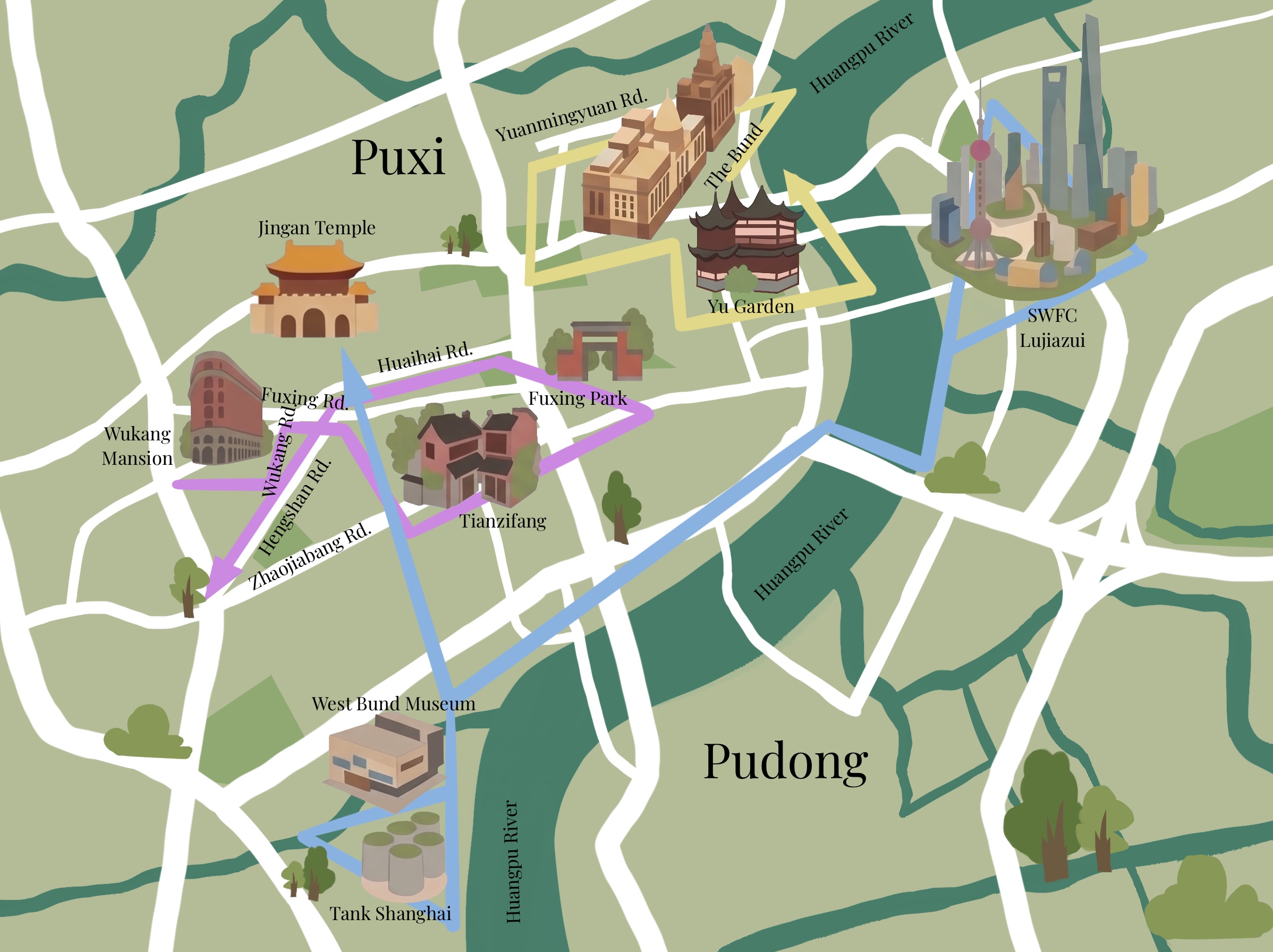
5-Day In-Depth Shanghai
- Colonial architecture and Shanghai's treaty-port history
- The Bund promenade, historic bank buildings, Waibaidu Bridge
- Huangpu River cruise in the evening
- Art Deco architecture and lane life at a slower pace
- Wukang Mansion area, Anfu Road, Fuxing Road, hidden lilong alleys
- Independent cafés, bookshops, vintage stores — no agenda, just walking
- Contemporary Chinese art and adaptive industrial architecture
- Power Station of Art, West Bund museum strip, M50 Creative Park
- Photography museums and riverside creative parks
- Traditional Jiangnan water architecture, canals, and regional cuisine
- Recommended: Zhujiajiao (1 hour by bus) or Suzhou (25 min by HSR)
- Qibao ancient town is a closer option within the city limits
Evening: Return to Shanghai for riverside dining and a final Bund night view
- Local lifestyle, independent creative culture, non-tourist neighbourhoods
- Columbia Circle, Yuyuan Road, North Bund, former industrial riverfront
- Suzhou Creek Industrial Trail — a free outdoor walking route through converted warehouses
Evening: Final skyline walk from the Bund and farewell dinner
Niche Routes
Theme-based itineraries for deeper exploration
These routes are designed for visitors who want to go beyond the headline sights — each one built around a single theme that rewards focused attention. Any of these can slot into a longer trip as a full day or afternoon.
- The Bund facade walk
- Wukang Mansion
- Peace Hotel exterior and lobby
- Former apartment buildings in the French Concession
- Old cinemas and ballrooms
Walking-heavy · Photography-focused · Best in autumn or spring
- Residential lilong neighbourhoods
- Wet markets and local breakfast shops
- Hidden cafés and independent bookstores
- Yongkang Road backstreets
- Yuyuan Road, Shaoxing Road, Ferguson Lane area
Slow travel · Cultural immersion · Local interaction
- Power Station of Art
- West Bund riverside museums
- M50 Creative Park
- Oil tank art spaces
- Riverside cycling and walking paths
Contemporary art · Urban planning · Best for creative professionals
- The Bund night walk
- Historic jazz bars in the French Concession
- Rooftop lounges with skyline views
- Night ferry on the Huangpu
- Late-night noodle shops and street food
Cinematic · Atmospheric · Ideal for photography
Getting There
Two airports, high-speed rail, and how to reach the city centre
From Pudong Airport (PVG)
- Metro Line 2 — cheapest¥8 to People's Square, ~60–70 minutes. Runs until ~11pm. Get off at People's Square, Jing'an Temple, or Hongqiao depending on your hotel.
- Maglev + Metro — fastest8 minutes to Longyang Road (¥40 with boarding pass), then Metro Line 2 to city centre. Total ~45 min. Worth it if you have heavy luggage.
- DiDi or taxi — most convenient¥150–200 to city centre, 60–90 min depending on traffic. Best option late at night when metro stops running.
From Hongqiao Airport (SHA)
- Metro Lines 2 or 10 — quick and easyLine 2 runs directly to People's Square and beyond. ~30–40 minutes to city centre, ¥5–7.
- Hongqiao Railway Station is connectedIf arriving by high-speed train from Beijing, Hangzhou, or Suzhou, you arrive at Hongqiao station — integrated directly with the airport terminal and metro.
By High-Speed Rail
- Beijing → Shanghai — 4.5 to 5.5 hours, ¥550–650 second classOne of China's most reliable rail routes. Book on Trip.com or the 12306 app.
- Hangzhou → Shanghai — ~45 minutes, multiple trains per hourMakes Hangzhou an easy day trip or stopover on the way in or out.
- Suzhou → Shanghai — ~25 minutes, extremely frequent
Getting Around
Metro, DiDi, bikes — and when to just walk
Shanghai's metro is one of the best in China — 21 lines, 500+ stations, bilingual signage throughout, and very cheap. For most journeys in the central districts it's faster than a taxi. The French Concession and Bund area are very walkable; Pudong is not — take the metro there.
| Option | Best For | Cost | Notes |
|---|---|---|---|
| 🚇 Metro | Almost everything in central Shanghai | ¥3–10 | Get a transport card at any station. Works on metro and most buses. |
| 🚗 DiDi | Late nights, luggage, awkward locations | ¥20–80 | Set up the app before arriving. Have destination in Chinese characters ready. |
| 🚲 Shared bikes | French Concession side streets | ¥1.5/30 min | Meituan and HelloBike bikes everywhere. Scan via WeChat or Alipay. |
| 🚶 Walking | French Concession, Bund area, Jing'an | Free | The best way to discover Shanghai. Most central sights are walkable from each other. |
| 🚕 Street taxi | Backup when no phone | ¥15–60 | Show destination in Chinese. Drivers rarely speak English. |
Day Trips
Easy escapes from Shanghai — all reachable in under 2 hours
Suzhou 苏州
China's classical garden capital. UNESCO-listed gardens (Humble Administrator's, Master of Nets), canals, and silk museums. Plan a full day — the gardens alone take 3–4 hours.
Hangzhou 杭州
West Lake and its surrounding tea hills are among the most beautiful landscapes in China. Rent a bike to circle the lake. Try Longjing green tea in its hometown.
Zhujiajiao 朱家角
An ancient water town within Shanghai's city limits. Stone bridges, canal boats, old tea houses, morning markets. Go early on a weekday to avoid weekend crowds. Entry ¥60 combined ticket.
Qibao 七宝
A smaller, more local water town reachable directly by metro (Line 9). Less polished than Zhujiajiao but more authentic. Free to walk around. Good for a quick half-day addition.
Practical Information
Everything you need before you arrive
| Topic | Details |
|---|---|
| Currency | Chinese Yuan (RMB / ¥). WeChat Pay and Alipay dominate — both now support international credit cards. Set one up before arriving. ATMs widely available for cash. |
| Language | Mandarin. More English than most Chinese cities — major hotels, tourist sites, and metro signage all bilingual. Save destination names in Chinese characters for taxis and shops. |
| Internet | Google, WhatsApp, Instagram, and most Western apps are blocked. Install a VPN before you arrive — it cannot be downloaded once inside China. See the internet guide. |
| SIM Card | Buy at Pudong or Hongqiao airport on arrival — China Mobile, Unicom, and Telecom all have desks. eSIM is also available via some overseas providers. |
| Emergency | Police 110 · Fire 119 · Ambulance 120 · Tourist helpline 12301 |
| Hospitals | Huashan Hospital Foreigners' Clinic and Shanghai United Family Hospital are most foreigner-friendly. Bring your passport. |
| Electricity | 220V / 50Hz. Type I (Australia-style) sockets common. European two-pin also widely fits. US visitors need an adaptor. |
| Tipping | Not expected or customary anywhere in Shanghai. High-end hotels may have international tip culture but it's never required. |
| Visa | Many nationalities qualify for 144-hour transit or 30-day visa-free entry. Check the visa page for current rules. |
Frequently Asked Questions
Common questions from first-time Shanghai visitors
Keep Reading
More guides to help plan your trip